The defining quality of universal AI is flexibility. It can enter an existing process, understand its internal logic and act from within it.
Early in a technology cycle, temporary constraints can look like the rules of the future.
Right now, we build cumbersome instruction systems around AI. We assemble context by hand, regulate agents, define skills and tools, and put elaborate technical layers between people and models.
It all works. More importantly, much of it is necessary today. But that does not mean it describes the technology in its mature form. We may simply be looking at an in-between stage.
Prompting followed the same pattern. Not long ago, it seemed that people would need a special language for talking to a model, a new interface with its own tricks, techniques and syntax. As models grew more capable, much of the need for “magic prompts” began to fade. Reading natural context proved more valuable than using the correct formula.
Agents may be on the same path, just at a larger scale.
Today we adapt environments and processes to AI. We structure context for it, describe tools, define rules and build harnesses that compensate for what the model cannot reliably understand or do on its own.
The next move belongs to AI. It needs to adapt to the environment.
Code, images, documents, interfaces and the history of a conversation are different formats for carrying information. The more universal a system becomes, the less the format itself should matter.
Its defining quality is flexibility: enter an existing process, understand its internal logic and act from within it. Build a rigid structure when it is needed. Work without one when it is not.
The half-life of tool knowledge is getting shorter
Traditional digital tools were relatively stable. Learning Photoshop, an IDE, a 3D package or a programming environment could pay off for years. The interface evolved, but the fundamental way of interacting with the tool changed slowly enough for deep expertise to accumulate.
AI changes that relationship.
A professional can spend six months mastering today’s preferred way of structuring context, agents, instructions and workflows. Six months later, a model may be able to infer much of that structure directly from the environment.
The knowledge was not wrong. Its half-life was simply very short.
This creates a strange situation. We are applying slow-tool thinking to tools that can fundamentally change the way we interact with them every few months.
The mistake is not building the harness. The harness solves real problems today.
The mistake is assuming the harness is the destination.
The paradigm of the digital tool changes here
Traditional software made people act as translators. To get a result, you had to translate your intention into something the system could understand: an interface operation, syntax, data structure, command or specialised workflow.
With AI, the direction of translation begins to reverse.
The technical system does not disappear. Interfaces, APIs, schemas, tools, workflows and code still exist. But increasingly, the model can translate human intention into operations across that system.
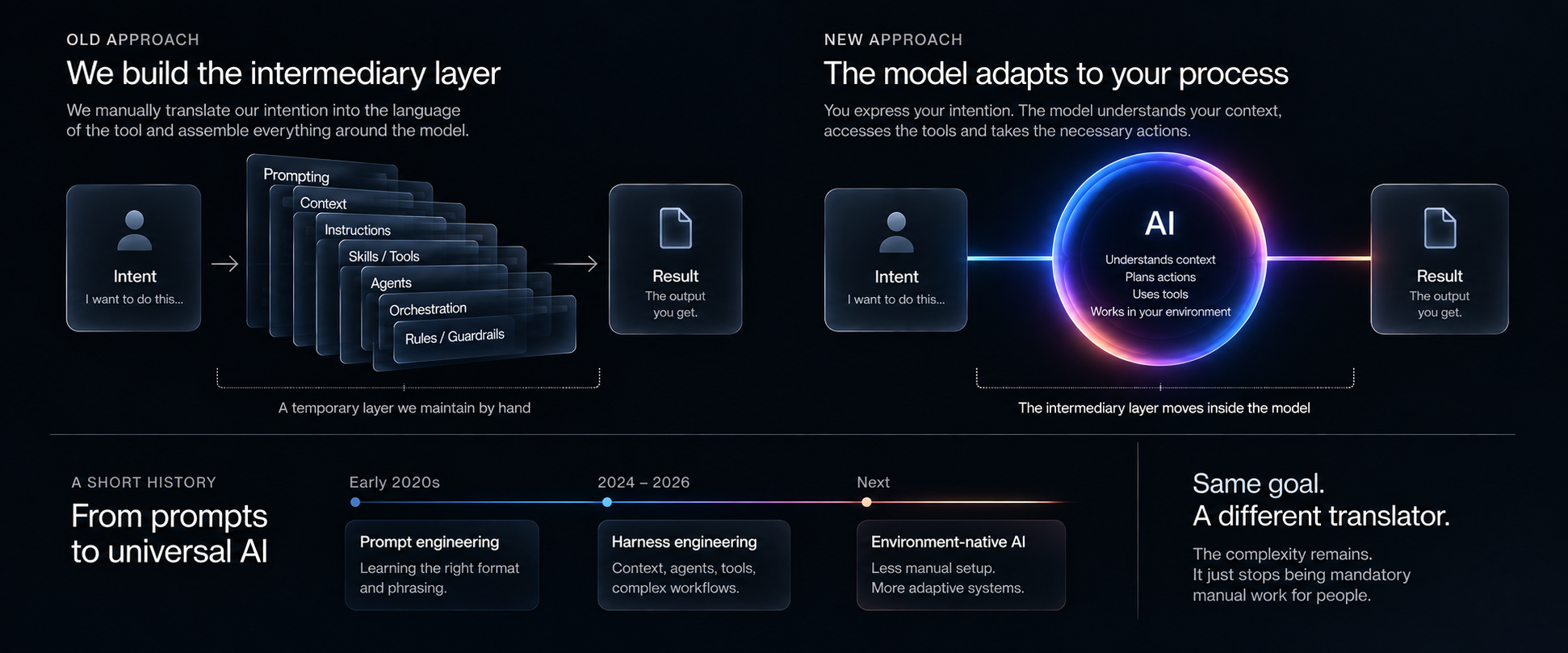
Old approach: Intention → Human translation → Technical system → Result
Emerging approach: Intention → AI translation → Technical system → Result
The complexity remains. What changes is who has to navigate it manually.
And that changes what knowledge is worth investing in.
Fine-tuning a particular agent, framework or harness is useful today. The next generation of models may quickly drain some of that expertise of value.
Understanding systems, architecture, constraints, cause and effect, and the subject domain lasts much longer.
The durable pattern is closer to this:
Goal → Context → Constraints → Actions → Verification → Result
The interface around that logic can change completely. It can be text today, an agent framework tomorrow, a visual environment after that, or something primarily conversational and multimodal. The underlying engineering logic survives.
You do not need to become a narrow specialist in every temporary layer around AI to remain a strong engineer, designer or builder. It matters more to see the whole system, frame the task correctly, understand its constraints and carry an idea through to implementation.
If AI is truly moving toward universality, professional focus belongs one level higher.
Use the harness. Learn enough to make it work. Build structure where the project requires it.
Just do not mistake today’s interface with AI for a permanent discipline.
Master the interaction logic, not the temporary interface.
Engineer the project, not the intermediary layer.
The future of AI is probably not another increasingly complex control panel between people and computers. It is the gradual absorption of that intermediary layer into the system itself.
The tool stops dictating the way of working.
It adapts to it.